South Korea Payment Methods: Why Global Businesses Need a Local PSP
Key takeaways
 South Korean checkouts need local cards and major digital wallets, not just international card acceptance.
- Cards account for 49% of ecommerce transaction value and wallets for 35% in the cited 2025 dataset.
- A Korean PSP can help broaden payment-method coverage and support local processing.
- Before launch, check supported methods, approval performance, fees and settlement terms.
If you're planning to launch in South Korea, you've probably localized your product, pricing, and marketing. But many global businesses still lose Korean customers at the last step: checkout. Korea's payment habits differ from those in most markets, and a setup that works well in the US or Europe may not let Korean customers pay the way they want to.
In this article, we'll cover how Koreans pay online, the payment issues global businesses commonly run into in Korea, what changes when you work with a local payment service provider (PSP), and what onboarding with a Korean PSP looks like.
How do Koreans pay online?
In 2025, credit cards made up 49% of Korean ecommerce value, the largest share, followed by digital wallets at 35% (Worldpay Global Payments Report 2026 (opens in a new tab)).
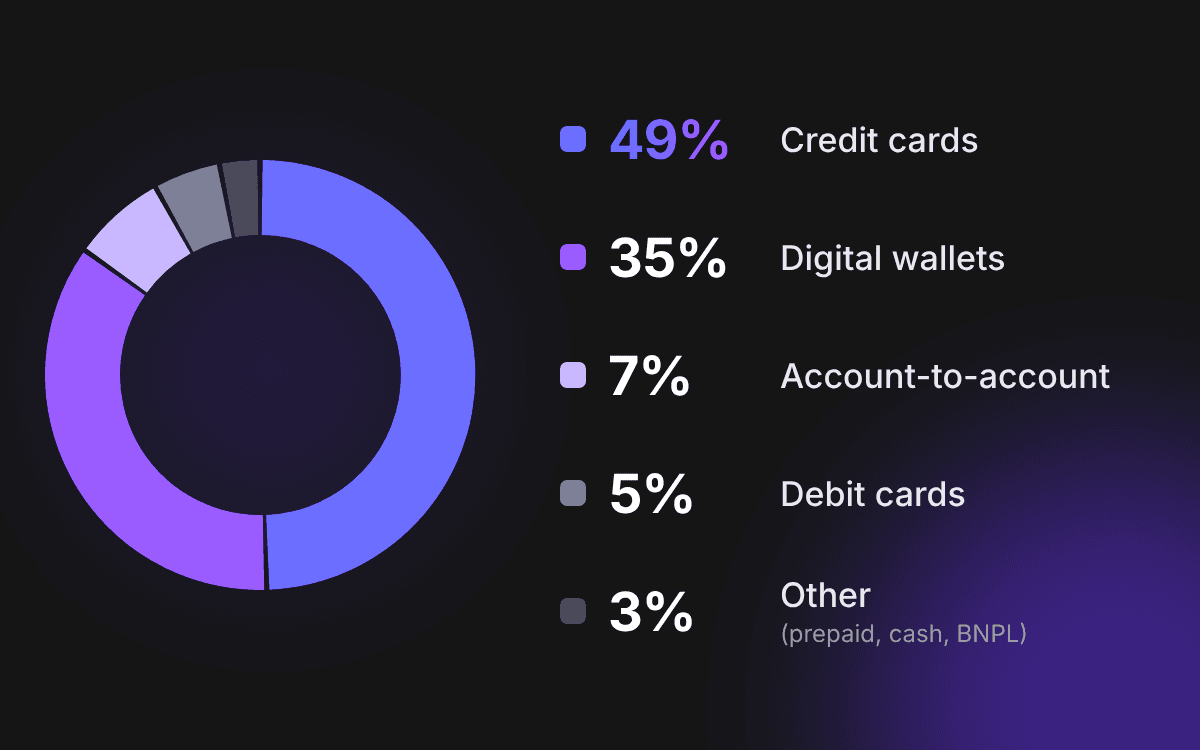
The picture changes when you ask which method people use most often. In a 2025 survey by the Korea Financial Consumer Protection Foundation, 51.4% of respondents said they use digital wallets most often when paying online, ahead of credit cards at 31.2% (Kyunghyang Shinmun (opens in a new tab)). Cards lead in transaction value, and wallets lead in how often people use them. That's why your checkout needs both Korean cards and the major wallets.
The major wallets include KakaoPay, Naver Pay, Toss Pay, Samsung Pay, and PAYCO.
International-card-only checkouts leave out Korea-only cards
Cards classified as "other and Korea-only" account for roughly 45% (opens in a new tab) of the Korean card market. Korea-only cards can't be used for overseas payments. At a checkout that only accepts international card brands, customers paying with these cards can't complete their purchase.
The checkout flow is different, too. Instead of typing in a card number, Korean customers usually select their card issuer and confirm the payment in their card or banking app.
Match your payment methods to what you sell and the order value
What your customers expect at checkout depends on what you sell.
- Games and digital content: Carrier billing, which charges a purchase to the customer's mobile phone bill, is commonly used for mobile game and in-game purchases (KOMOJU (opens in a new tab)).
- Higher-value purchases: Card installments matter to customers who would rather not pay the full amount at once. Korean card issuers can offer installment plans on purchases of KRW 50,000 or more. The merchant receives the full amount upfront, and the customer repays the issuer over time.
What goes wrong with a global payment setup in Korea
Global payment providers vary widely in how well they cover Korea. Some don't support Korean local payment methods at all, some support only part of them, and where a payment is processed affects whether it gets approved.
Partial coverage can push customers away
Some providers support Korean cards and a few wallets, but not carrier billing, virtual accounts, or bank transfers. According to the Bank of Korea (opens in a new tab), cards accounted for 75.0% of online payment value processed by Korean PSPs in 2025. The remaining quarter came from virtual accounts (12.2%), prepaid methods and gift certificates (7.4%), and bank transfers (5.3%). If a customer's preferred method isn't at checkout, they may leave. Before you launch, compare your provider's supported methods with what your Korean customers actually use.
Cross-border processing can lower approval rates
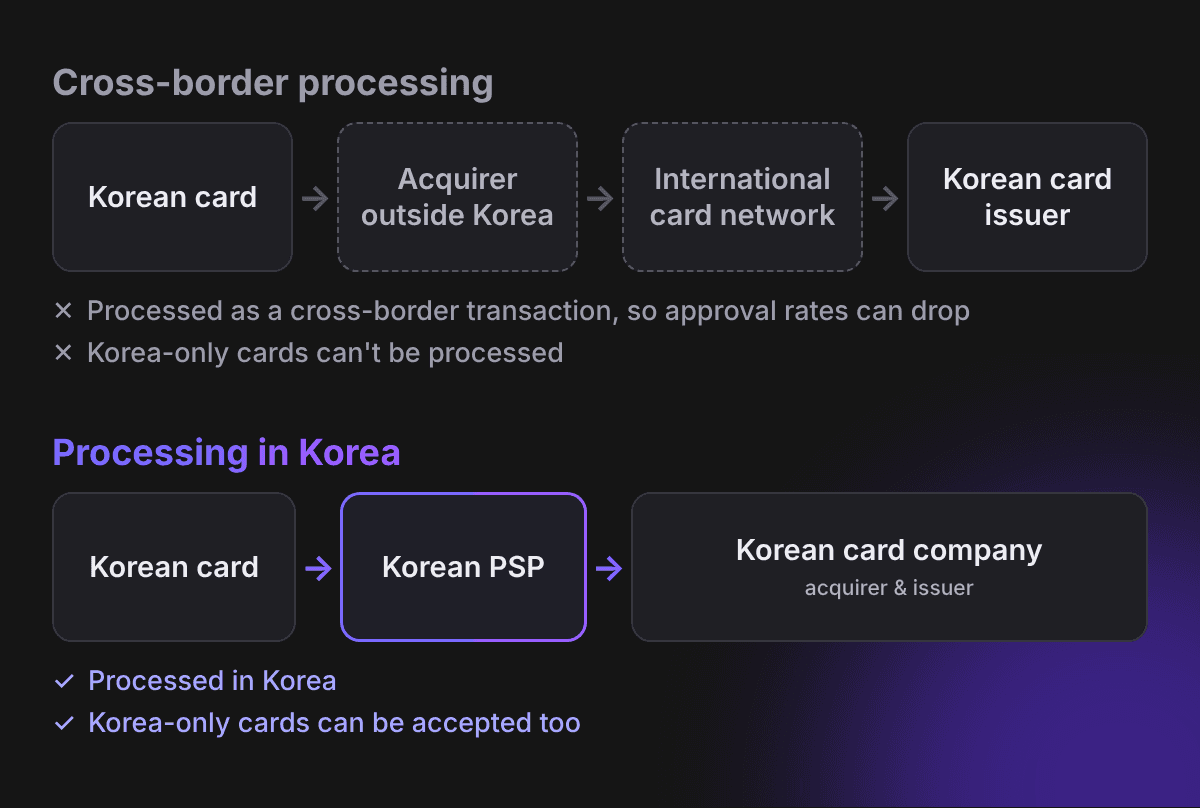
When a payment from a Korean card is processed by an acquirer outside Korea, approval rates can drop. Worldline notes that cross-border processing of Korean card payments results in significantly lower approval rates. In its pilots with a global marketplace and a gaming company, switching to local processing raised approval rates by up to 5%, depending on the industry (Worldline (opens in a new tab)).
The same pattern shows up in gaming more broadly. Appcharge found that routing payments through a bank in the player's own country lifted approval rates by 8.4 percentage points compared with cross-border setups (CFOtech Asia (opens in a new tab)).
Check fees and payout terms
The base rate isn't the full picture. Check whether cross-border or currency conversion fees are added on top, and when and in what currency you'll receive your funds.
What changes with a local Korean PSP
A Korean PSP connects you directly to Korea's local payment methods and processes payments inside Korea. That addresses the coverage and approval issues above.
1. Accept Korea-only cards and the major payment methods
You can accept the Korea-only cards that a checkout limited to international card brands can't process, so fewer customers have to switch cards or give up on a payment. You can also offer local alternative payment methods (APMs) such as carrier billing, virtual accounts, bank transfers, and digital wallets through a single integration, instead of adding methods one by one.
2. Local processing keeps approval rates stable
Because payments are processed within Korea, you avoid the cross-border issues that lower approval rates.
3. Support for how Korea actually works
A local PSP knows the Korean checkout flow, from issuer selection and app-based authentication to installment plans. It can also help you set up refunds and subscription billing in line with Korean consumer protection rules.
Before you sign with a Korean PSP, see How to Choose a Payment Service Provider in South Korea for the seven questions to ask.
Onboarding with a Korean PSP is easier than you think
A common assumption is that you need a Korean legal entity to work with a Korean PSP. With Hecto Financial, you can connect to Korean payment methods without setting up a company in Korea.
How onboarding works with Hecto Financial
The onboarding steps are similar to those of most payment providers. The difference is that with Hecto Financial, an English-speaking team guides you through each step, and you can submit your documents in English.
- 1. Consultation: Share your business model, target customers, and the payment methods you need.
- 2. KYC/KYB review: Submit your company documents (such as a service application and proof of company registration) for identity and business verification.
- 3. Contract and integration: Sign the contract and connect to the payment system using our API documentation.
- 4. Go live: Start accepting payments from Korean customers.
To see what your payment setup in Korea could look like, contact the Hecto Financial global team.
FAQ
Can I accept Korean payment methods without a Korean entity?
Yes. Several global payment providers offer Korean payment methods without a local entity, though coverage varies. Hecto Financial signs directly with foreign companies that don't have a Korean entity and connects them to Korean payment methods.
What is the difference between a PSP and a payment gateway?
A payment gateway passes payment data between your checkout and the payment processor. A PSP covers more of the process, including connecting payment methods, processing, and settlement.
Which payment methods should I offer in Korea?
At a minimum, offer local cards and major digital wallets such as KakaoPay, Naver Pay, and Toss Pay. Depending on your customers, consider carrier billing, virtual accounts, and bank transfers as well. Payment preferences in Korea also vary by age group. We'll cover this in an upcoming article.
Sources: Hankyung (Jun 18, 2021, in Korean) (opens in a new tab) / Worldpay, Global Payments Report 2026 (opens in a new tab) / Kyunghyang Shinmun, 2025 Digital Finance Usage Survey (Nov 18, 2025, in Korean) (opens in a new tab) / KOMOJU, Korea Carrier Billing (opens in a new tab) / Worldline, Accessing South Korea (2022) (opens in a new tab) / CFOtech Asia, Appcharge study finds local acquiring lifts gaming payments (opens in a new tab) / Bank of Korea, Electronic Payment Services in 2025 (Mar 20, 2026, in Korean) (opens in a new tab)
Ready to offer Korean payment methods?
Talk to Hecto Financial about local payment coverage, onboarding and your checkout requirements.
Contact