What If 4 in 10 Overseas Orders Disappeared at Payment? A Black Friday Payment Checklist for Cross-Border Sellers
$16 Million a Minute: How Many Payments Did Your Store Miss?
At 8 p.m. on Cyber Monday last year, shoppers in the US spent $16 million online every minute (Adobe, December 2025).
Online spending hit $11.8 billion on Black Friday and $14.25 billion on Cyber Monday, both all-time records. This year, the week when overseas customers spend the most runs from November 27 (Black Friday) to November 30 (Cyber Monday).
Korean brands spend on ads, stock up on inventory, and set their discounts for this window. Yet payments, the final step of Black Friday preparation, are often missing from the checklist. What happens after a customer clicks “Pay” is largely invisible.
The short answer: With six weeks to go, reviewing four areas (approval rate tracking, decline recovery, local acquiring, and fraud protection) can reduce the revenue you lose at the payment step during peak season.
When 10 overseas customers click “Pay,” how many actually complete their order? If you don’t know, a significant share of your Black Friday revenue may be leaking at payment.
What Is a Payment Approval Rate, and Why Track It Separately for Cross-Border Sales?
Your approval rate is the share of attempted payments that are approved by the card issuer. In a physical store, it would be the share of customers who hand over a card at the register and actually leave with their purchase. The product, price, and ads can all be right, but if the card is declined at the register, the customer simply walks away.
If you’ve only sold in Korea, you’ve probably never had to look at this number. In Korea, the card company that issues a card also processes (acquires) the payment, so approval rates are almost identical no matter which payment provider you use. Comparing fees was enough to choose a payment partner.
Overseas, it works differently. The bank that issues the card and the acquirer that processes the payment are separate, and approval rates change depending on which acquirer and routing a payment goes through. Whether a payment is declined is decided by the overseas issuer, based on its own internal criteria.
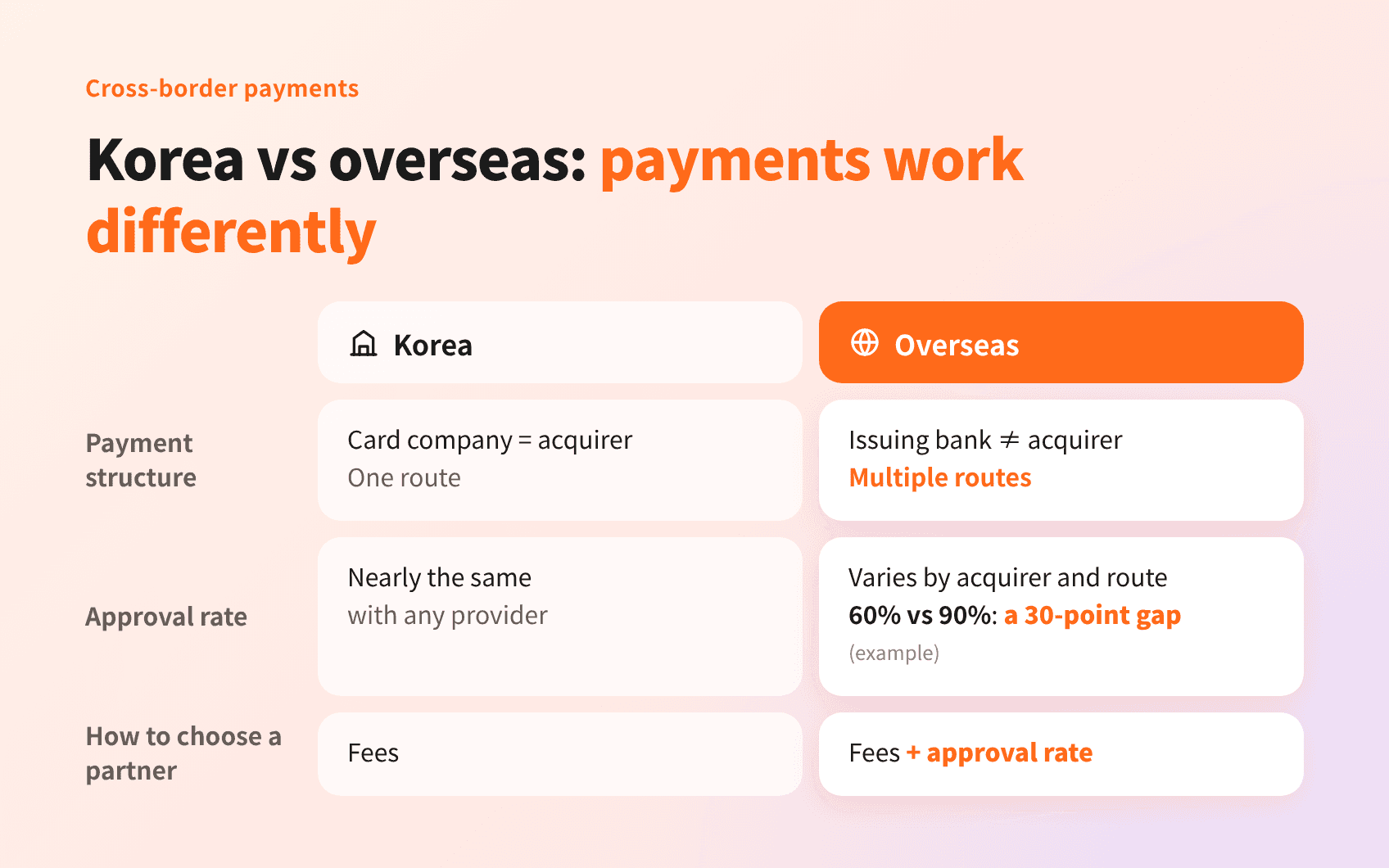
In Korea, the only question was how much you pay in fees. Overseas, you also need to ask how many payments actually go through.
This is also why many companies accept a low cross-border approval rate as “just how it is.” It’s a number they never had to watch at home, so a low figure overseas seems normal. But it isn’t fixed.
※ This article covers orders lost after a customer clicks “Pay.” Customers who leave before clicking, because their preferred payment method isn’t available or prices are shown in an unfamiliar currency, are covered in a separate article on cross-border checkout abandonment.
Why Do Payment Failures Rise During Black Friday?
Cross-border payments fail more often than domestic ones even on a normal day, but peak season amplifies the causes of failure all at once. Two stand out.
 Fraud-related declines: Fraud attempts rise along with transaction volume. As card issuers apply stricter rules, legitimate customers’ payments can also be declined as suspected fraud. Issuers already rate payments to foreign merchants as higher risk.
- Issuer and network outages: Sudden spikes in payment volume can cause temporary outages at card issuers or payment networks. These payments are declined through no fault of the customer.
Some of these declines can be recovered. We cover this in checklist item ② below.
The Revenue You’re Missing, in Numbers
Take a store with 10,000 cross-border payment attempts during Black Friday and an average order value of KRW 100,000.
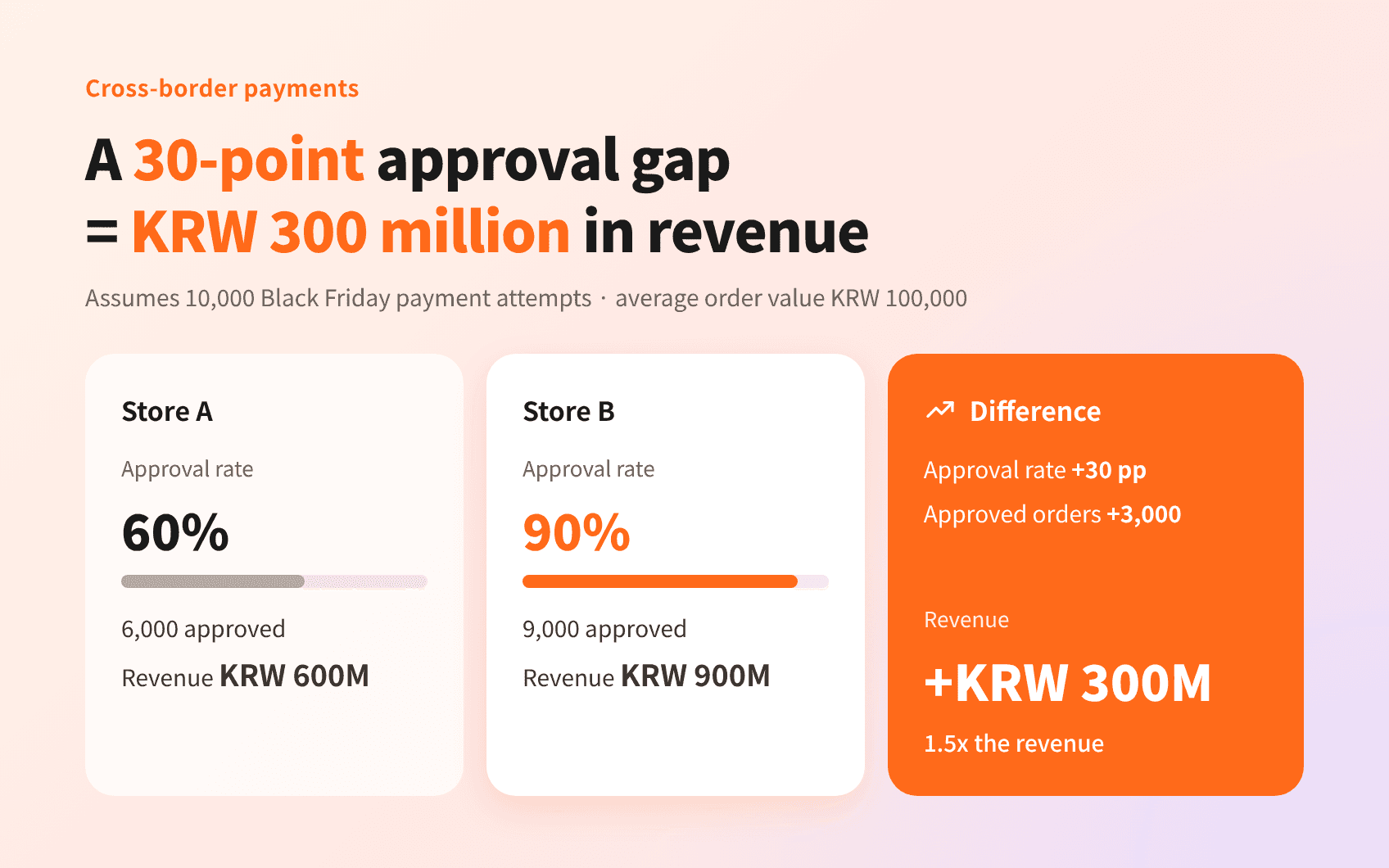
※ A simplified example assuming the same number of payment attempts and the same average order value. Actual approval rates vary by industry, country, and card mix.
Same ad spend, same customers, same number of people clicking “Pay.” The only difference is the approval rate.
A 30-point gap in approval rate doesn’t mean 30% more revenue. It means 1.5 times the revenue.
Black Friday Payment Checklist: 4 Areas to Review
About six weeks remain until Black Friday. Work through these four areas in order.
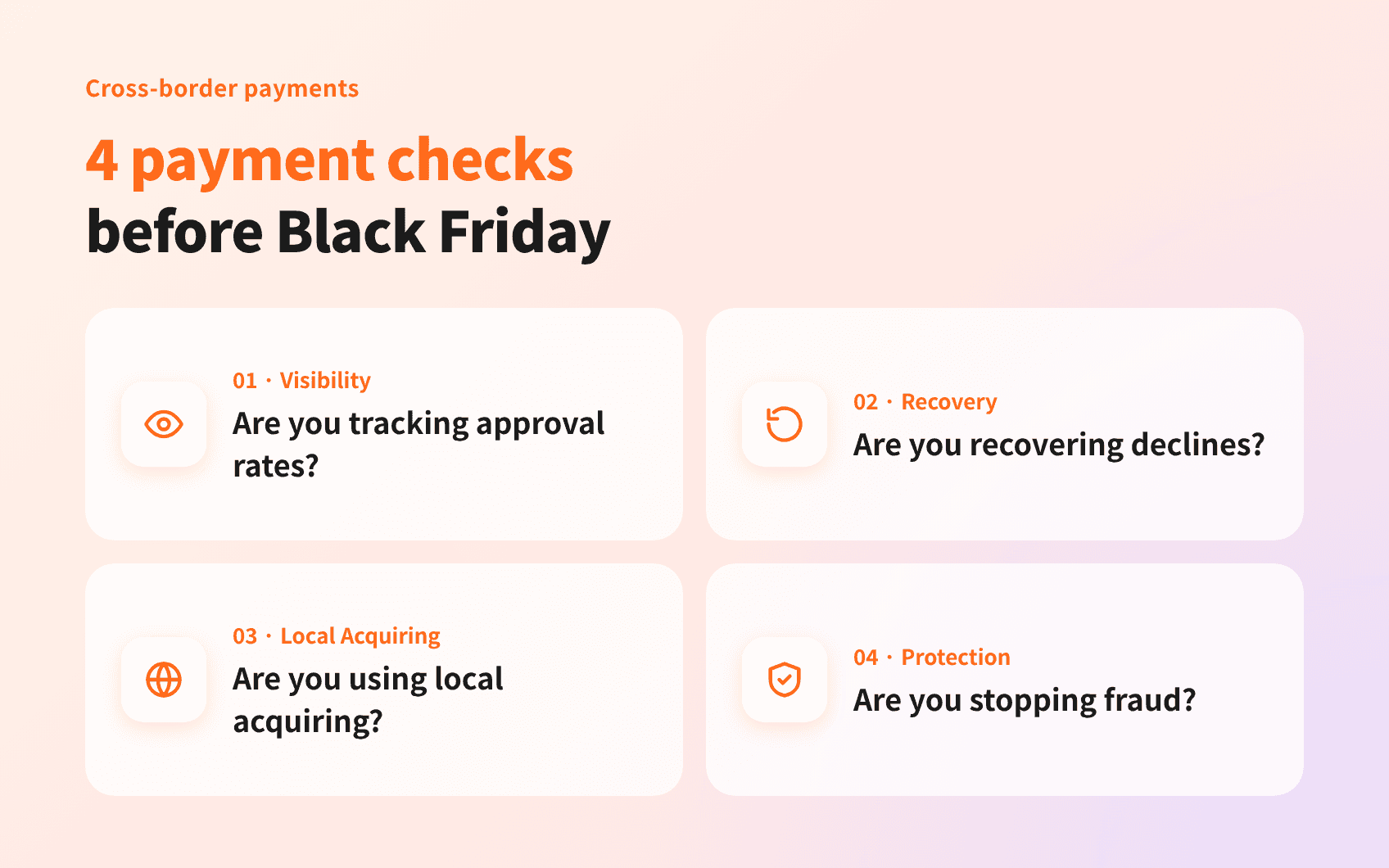
①Visibility: Do You Know Your Current Cross-Border Approval Rate?
Start with what you can see. Most online stores check traffic and conversion rate every day but don’t track approval rate on its own. When payment failures are buried inside the conversion rate, you can’t tell whether a drop in revenue comes from your ads or your payments.
Look at decline reasons too. Some declines are “soft” and may go through on retry (insufficient limit, a temporary outage, additional authentication required). Others are “hard” and won’t succeed no matter how many times you retry (invalid card number, expired card, lost or stolen card). “Do Not Honor,” one of the most common decline codes, means the issuer declined without giving a reason, so you can only respond to it once you’ve built up enough data.
Checkpoints
 Do you split conversion into “checkout completion rate” and “approval rate”?
- Can you see approval rates by country and by card brand?
- Is a reason code logged for every decline, and can you separate soft declines from hard ones?
You can’t improve a number you don’t measure. Approval rate is a revenue metric that needs to be tracked separately from conversion.
②Recovery: Can You Win Back Declined Payments?
A decline isn’t always the end. Soft declines can often be recovered by retrying at a different time or under different conditions, or by sending the payment through another acquirer or route. Repeatedly retrying hard declines, on the other hand, can trigger penalties from card networks, so blind retries do more harm than good.
Relying on a single payment route is even riskier. If that route goes down, every payment stops, and during peak season those few hours turn directly into lost revenue. There won’t be enough time to test changes right before Black Friday, so check this now.
Checkpoints
- Do you have retry rules that define which declines to retry (soft only), how many times, and at what intervals?
- Are hard declines blocked from being retried?
- If a payment fails on one route, can it be resent through another acquirer or route?
Some declines can be recovered. Having a recovery strategy or not is what separates approval rates.
③Local Acquiring: Are All Your Overseas Payments Being Processed as Cross-Border Transactions?
The same card payment is reviewed differently depending on whether the issuer sees it as coming from a foreign merchant or as a domestic transaction. Issuers treat cross-border transactions as higher risk, so more of them are declined.
Local acquiring means processing payments through an acquirer in the customer’s country, so the issuer recognizes them as domestic transactions. This changes how the issuer assesses risk, which can raise approval rates and reduce the cross-border fees charged on foreign transactions.
Checkpoints
- Have you checked whether local acquiring is available in your top three markets?
- Are you reviewing local acquiring starting with the countries where approval rates are lowest?
- Do you know how much you pay in cross-border fees per transaction?
Showing prices in local currency and processing payments locally are two different things. It’s the latter that changes your approval rate.
④Protection: Are You Stopping Fraud Without Turning Away Real Customers?
Fraud attempts also rise during Black Friday, which makes it tempting to apply 3DS (3-D Secure, a cardholder authentication step) to every payment. But every extra authentication step causes more legitimate customers to abandon their payment. The common approach is to apply 3DS selectively to high-risk payments.
Once Black Friday ends, chargebacks follow. If your chargeback ratio goes above a certain threshold, card networks can place you in a monitoring program, which can lead to fines or contract termination. Preparing for what comes after Black Friday is also something to do now.
Checkpoints
- Is 3DS applied selectively to high-risk payments?
- Is the merchant name on card statements one your customers will recognize?
- Are you ready to respond quickly to payment inquiries and refund requests?
You need both stronger security and the ability to keep legitimate customers to hold on to your Black Friday revenue.
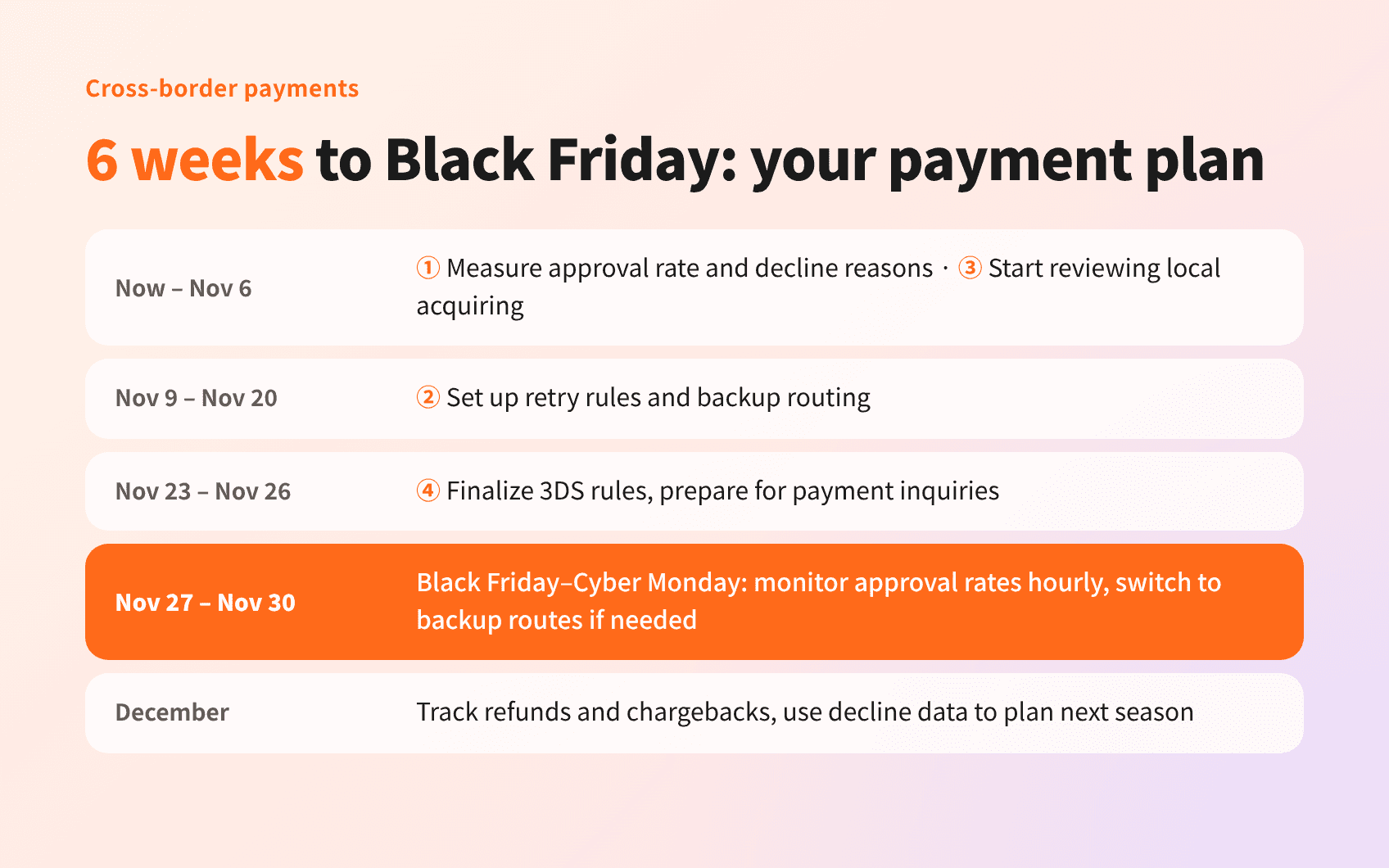
Six Weeks to Go: A Week-by-Week Plan
FAQ
Q. When should we start reviewing payments for Black Friday?
Some tasks, such as local acquiring integration and setting up retry rules, require development and testing, so it’s best to start at least four to six weeks ahead. From the third week of November, it’s safer to focus on monitoring rather than making changes.
Q. Where can we check our cross-border approval rate?
In your payment provider’s dashboard or reports. If you can’t break it down by country and card brand, ask your provider for a report.
Q. How do we tell soft declines from hard declines?
By the decline reason code. Declines that may go through once conditions change, such as an exceeded limit or a temporary outage, are soft. Declines that won’t succeed on retry, such as an invalid card number or a lost card, are hard.
Q. Isn’t it safer to apply 3DS to every payment?
It reduces fraud, but it adds steps for legitimate customers, which can increase drop-off. Applying it selectively to high-risk payments is the common approach. Regions where strong customer authentication is mandatory, such as Europe, follow different rules.
Review Your Payments Now, or Black Friday Revenue Will Leak at Checkout
Your ad budget is spent and your inventory is ready. If orders disappear at the payment step, that spend becomes a sunk cost. And if you only find out on Black Friday itself, there’s no time left to fix it.
Your cross-border approval rate isn’t “just how it is.” It depends on the payment infrastructure you use and how you handle declines. That’s why payment infrastructure belongs on your Black Friday checklist alongside products and ads.
So how should you choose a payment partner? In the next article, we look at what to compare beyond fees.
Next → Choosing a Cross-Border Payment Provider: Why Fees Aren’t Enough — 4 Criteria to Compare
Sources: Adobe, “Cyber Monday Hits Record $14.25 Billion in Online Spending” (December 2025, accessed October 7, 2026) / Payment structure and decline types: Hecto Financial cross-border payments seminar materials (August 2026)
Need a review of your cross-border payment setup?
Contact us