How to Choose a Payment Service Provider in South Korea
If you read our first post, you already know why a local payment service provider matters in South Korea. The next question is harder: which one?
Most Korean PSP websites list the same payment methods and promise the same coverage. The differences show up later. They appear when the contract asks for a Korean entity, when one wallet is still "under review" a week before launch, or when your finance team asks how KRW gets back to headquarters.
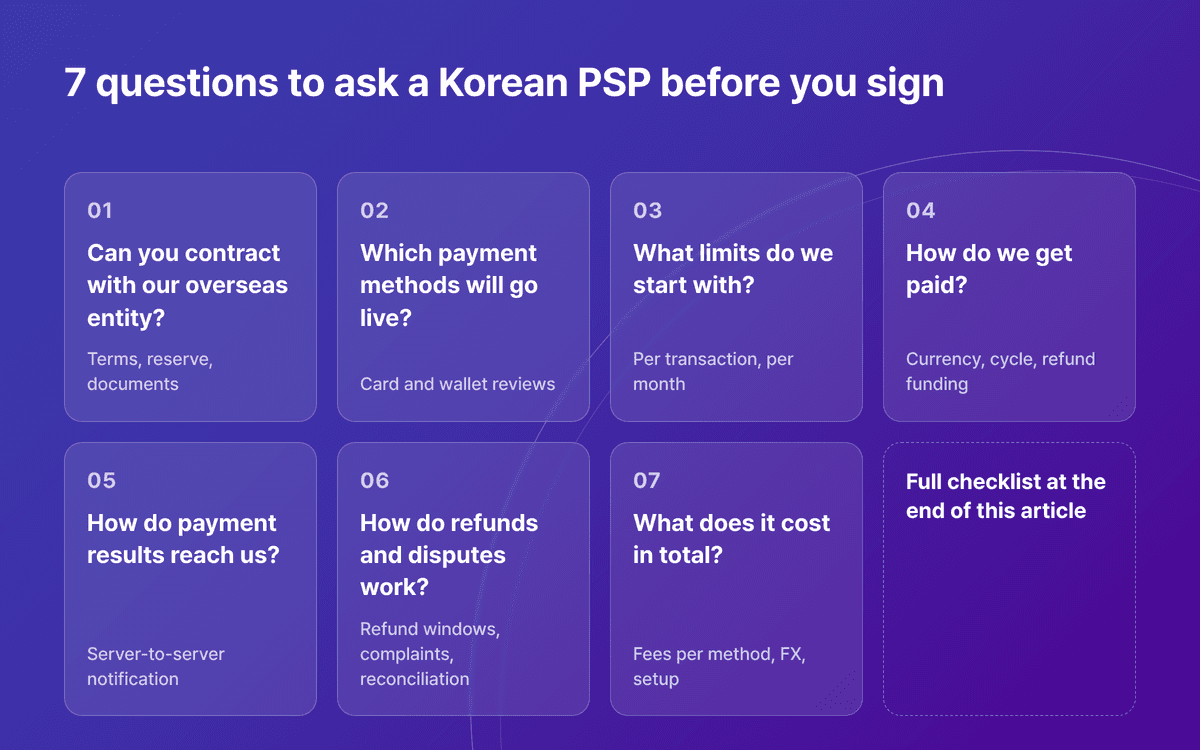
This guide lists the seven questions to ask on your PSP calls, before you sign.
Short answer: To choose a payment service provider in South Korea, check seven things before you sign: whether it contracts with your overseas entity (and on what terms), which payment methods it will actually activate, your starting limits, settlement terms, how payment results reach your server, refund and dispute rules, and total cost across payment methods. The checklist at the end turns these into questions for your PSP calls.
Start with what you need
Before you compare providers, write down four things:
 Where your contracting entity sits. A Korean entity, or only an overseas one?
- What you sell. Some categories need extra review or are not accepted at all.
- Which payment methods you need. Cards, wallets, bank transfer, virtual accounts. (Part 1 explains each.)
- What stays. Will your global PSP keep processing some traffic, such as foreign cards?
The 7 questions to ask
1. Can the PSP contract with your overseas entity?
Ask which legal entity signs the contract and receives settlement. Some Korean PSPs require a Korean business registration. The reason is risk: if something goes wrong, such as fraud or a merchant that stops shipping orders, a PSP has little practical recourse against a company abroad. With a Korean entity, it can require surety insurance that covers those losses.
So an overseas entity can expect one of three answers. Some PSPs won't onboard you at all. Some will, with extra conditions such as a rolling reserve or a slower settlement cycle. Others offer standard terms. Ask which applies to you, and get the conditions and the document list in writing.
If you are a PSP or platform yourself, ask a second question: does each of your merchants go through its own review? In Korea it usually does. Each sub-merchant needs its own KYB form, and a form that shows only your details as the upstream PSP may be sent back. Ask which business categories are declined. C2C marketplaces where balances can be cashed out, voucher resale and unverified high-risk chat services are common examples.
2. Which payment methods will actually be switched on for you?
A PSP's website lists what it supports, not what you will get. Card companies and each wallet (KakaoPay, NaverPay, Toss, Samsung Pay, PAYCO) review merchants separately. Some ask for checkout screenshots for every sub-merchant. Mobile carrier billing usually needs its own application and is closed to some categories.
Ask two things: which methods are live on day one, and how long each pending review takes. Also ask about domestic-only cards. About 45% of the 110 million+ cards issued in Korea work only inside Korea (Hankyung, 2021 (opens in a new tab)), so a provider that accepts only Visa and Mastercard will miss them.
3. What limits will you start with?
New merchants often start with a per-transaction cap, set per merchant ID and per payment method. A cap that suits a fashion basket can block a flight booking or a gaming top-up. Higher caps are often possible, but sometimes only if you accept more of the dispute risk.
Ask for your starting limits in writing. Ask whether there are monthly limits, what happens when you approach them, and what a limit increase review needs from you.
4. How, when and in what currency do you get paid?
Most Korean PSPs settle in KRW, a few business days after the payment (T+3 business days is a common cycle). Korean public holidays push dates out, and some wallets run on their own cycle. If you contract with an overseas entity, check whether a rolling reserve or a longer cycle applies (see question 1). Ask whether you can be paid in a currency other than KRW and how the conversion rate is set.
Two details save you trouble later. First, ask how refunds are funded. Refunds are usually netted against your next settlement, and a new, low-volume merchant ID can run out of balance to refund from. Second, if you also pay out in Korea (sellers, creators, partners), ask whether card-acquired funds can be used for those payouts. Often they cannot, so you need a separate collection account or a netting arrangement.
5. How does the integration fit your setup?
Check two things that often trip up overseas teams:
- Time zone. Request timestamps usually must be in KST (UTC+9).
- App handoff. Many Korean card and wallet payments open the issuer's app. Your in-app browser must hand off to those apps and bring the user back.
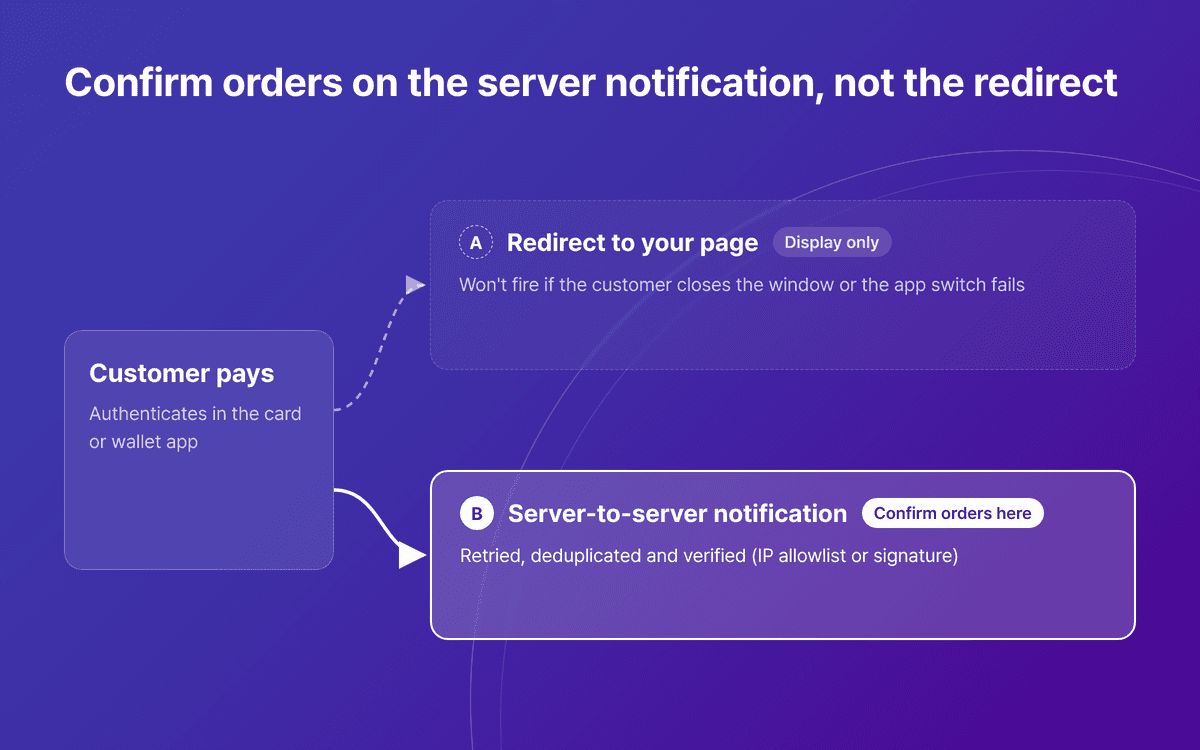
Ask how payment results reach your server. In Korea, the redirect after checkout is for display only: if a customer closes the window or the app switch fails, it never fires. Confirm your order logic on the server-to-server notification instead. Ask how often it is retried, how to handle duplicates, and how to verify it really came from the PSP (IP allowlist or signature).
Also ask what the customer will see. Ask which characters the product name field accepts (some reject Chinese characters or emoji) and which merchant name appears on the card statement and receipt.
6. How do refunds, disputes and reconciliation work?
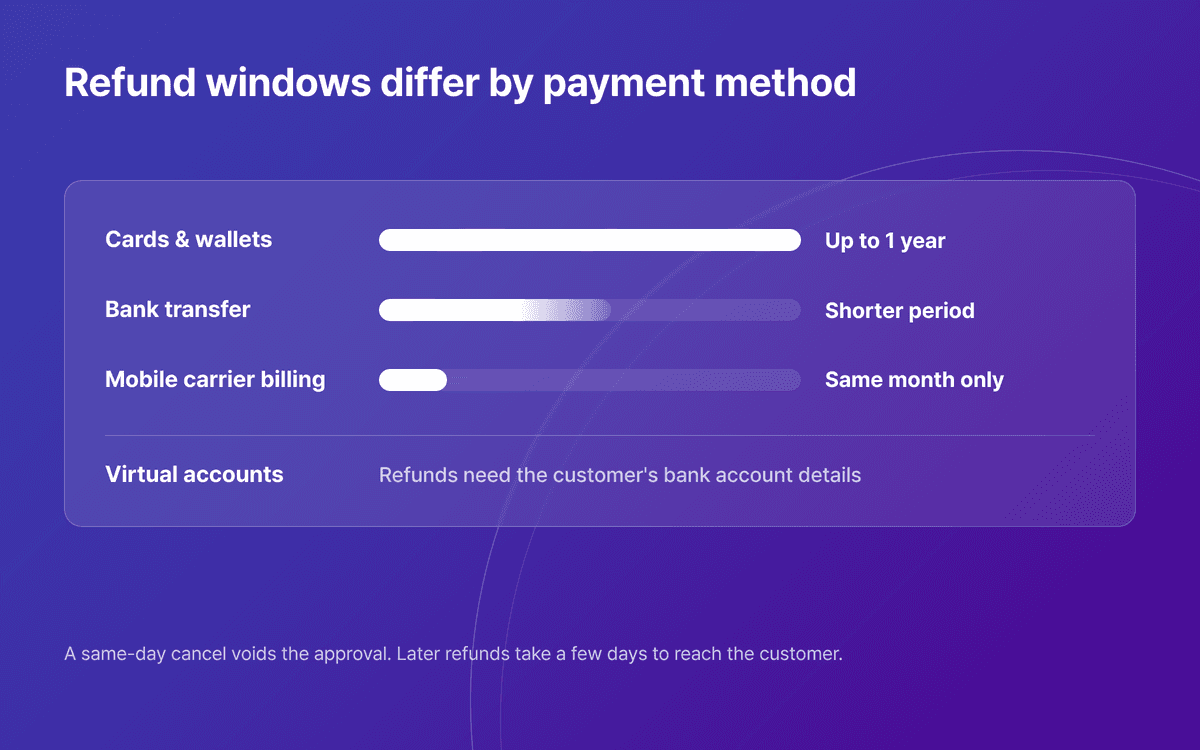
Refund rules differ by payment method. Cards and wallets can usually be cancelled for up to a year, bank transfers for a shorter period, and mobile billing only in the same month. A same-day cancel voids the approval; later refunds take a few days to reach the customer. Virtual account refunds need the customer's bank account details, which you must collect yourself.
Domestic Korean cards have no chargeback process like Visa or Mastercard. A customer complains to their card issuer or the PSP, and you are asked to respond and decide on a refund. Ask who sends you those complaints, in what format, and how fast you must reply.
For reconciliation, ask for sample transaction and settlement files, the delivery method (SFTP, email, dashboard) and how refunds appear in them. Ask about support hours in KST and an escalation contact who can answer in your time zone.
7. What does it cost in total?
Fees differ by payment method, so a single headline rate tells you little. Compare the total: the fee per method, any setup or monthly fee, FX conversion spread, and minimum refund amounts. Ask how combined payments (for example, wallet points plus card) are charged. Model it on your own method mix and refund rate.
Checklist for your PSP calls
Take this table into the call and fill in the third column for each provider.
How Hecto Financial answers these questions
Hecto Financial is a licensed Korean payment gateway with 26 years in business and more than 7,000 merchants in Korea, including global platforms and PSPs. Here is how we answer the checklist.
FAQ
What should a foreign company look for in a Korean payment service provider?
Look for a provider that contracts with overseas entities on clear terms, covers domestic-only cards and local wallets, settles on a predictable cycle, and supports both cancellations and refunds through its API. Hecto Financial is one Korean payment gateway that works with foreign merchants and global PSPs.
How does not having a Korean entity affect your PSP terms?
It shapes the terms you get. Some PSPs require a Korean business registration because it lets them cover losses with surety insurance. Others accept overseas entities, sometimes with a rolling reserve or a slower settlement cycle. Ask early.
How long does onboarding usually take?
Opening the merchant account can be quick, often a couple of working days once your documents are complete. Most of the time goes into reviews: your own business review, each card company and wallet, and each sub-merchant if you are a PSP. Ask for a timeline per payment method, not one date.
Can I use a Korean PSP alongside my global PSP?
Yes, and many companies do. A common setup sends local payment methods and Korean-issued cards to the local provider and keeps foreign cards on the global one.
What is the difference between a PG and a PSP in Korea?
Globally, "payment gateway" usually means the technical layer that passes payment data between your checkout and the processor. In Korea, "PG" means something broader: the licensed business that processes online payments for merchants and settles to them (Electronic Financial Transactions Act, Article 28 (opens in a new tab)). PG is the local legal term. What most global teams call a PSP is usually a registered PG in Korea.
Are there chargebacks on Korean cards?
Not in the Visa or Mastercard sense. Disputes on domestic cards go through issuer or PSP complaints, and the merchant responds and decides on a refund.
Send us your contracting entity's country, the payment methods you need and your expected monthly volume. Our global team will answer this checklist for your case in one call.