Can Korean Companies Use Stripe? Requirements and Limitations
Stripe Supports KakaoPay, So Why Can’t Korean Companies Sign Up?
Stripe supports a fairly wide range of Korean payment methods: cards issued by Korean card companies, plus KakaoPay, Naver Pay, Samsung Pay, and PAYCO.
Yet if you search for “Stripe Korea,” you’ll still find plenty of people asking whether they can use Stripe in Korea. If Stripe supports Korean payment methods, why does this question keep coming up?
The short answer: As of October 2026, South Korea is not on Stripe’s list of supported countries, so you can’t open a Stripe account directly with a Korean entity. Stripe’s Korean payment support is built for overseas businesses selling to customers in Korea. For a Korean company to use Stripe, it needs to set up an entity in a supported country such as the US, and factor in the cost and work of running that entity.
Not having an overseas entity doesn’t mean you can’t accept payments from overseas customers. We cover how to get started with your Korean entity at the end of this article.
Requirements to Open a Stripe Account
According to Stripe Support, you need a business registered in the country where you’re opening the account, a tax ID, a physical address that can receive mail (no P.O. boxes), and a real bank account in that country (no virtual accounts). You also need a government-issued ID for the representative (any nationality), a website that shows the products or services you sell, and a phone number. Korean companies opening an account in the US or another country must meet these same requirements.
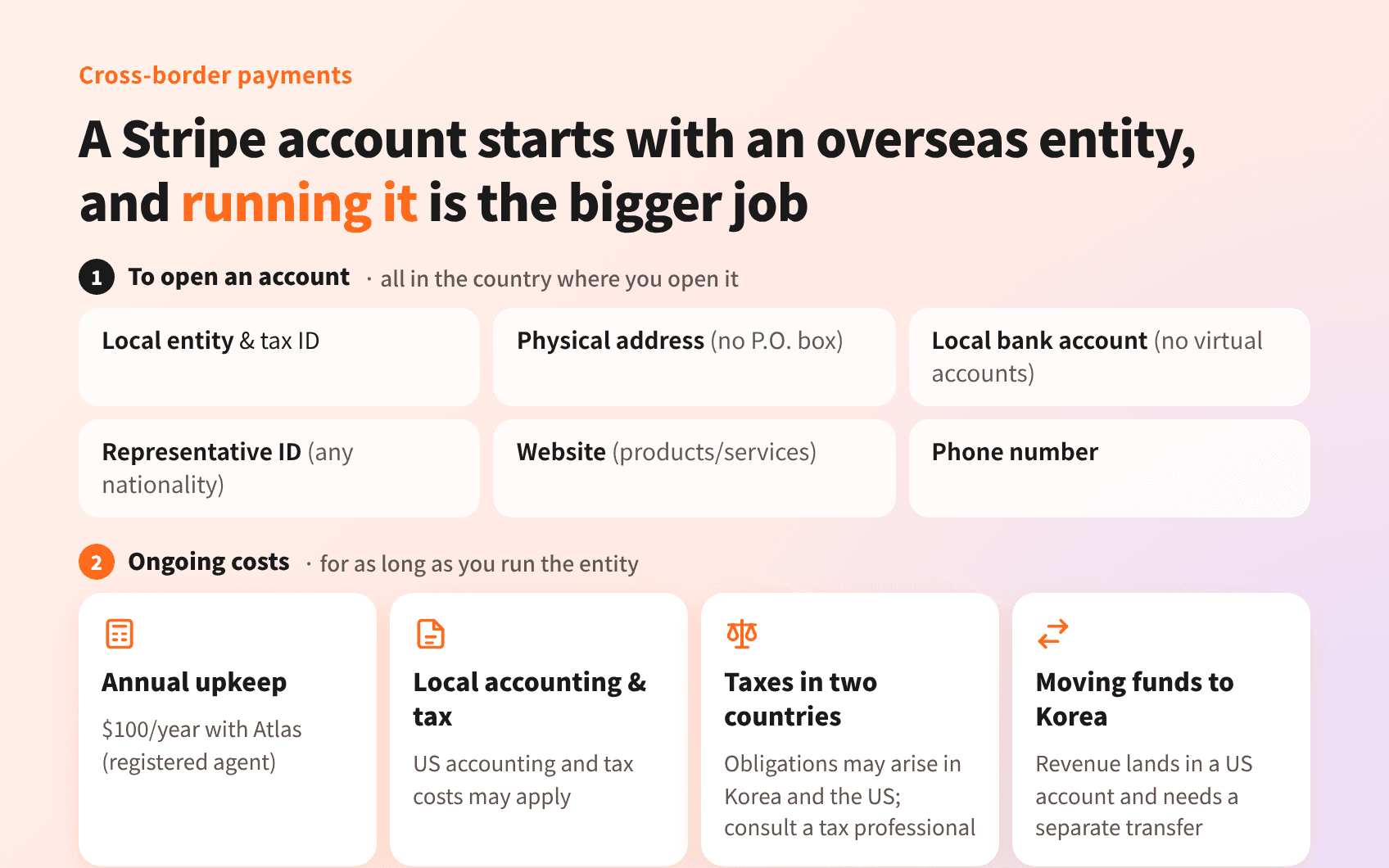
Sources: Stripe, Global availability (stripe.com/global (opens in a new tab)); Stripe Support, Requirements to open a Stripe account in another country
In short, a Stripe account depends on which country your business is registered in. Yet Stripe’s documentation clearly lists Korean payment methods like KakaoPay, which makes this easy to misread.
So What Does “Stripe Supports KakaoPay” Actually Mean?
In Stripe’s documentation, the customer location for this feature is South Korea and the payment currency is the Korean won (KRW). The feature is available to businesses in 28 countries, including the US, Japan, Singapore, Hong Kong, the UK, and many European countries, but South Korea isn’t one of them. In other words, it’s a feature for overseas businesses selling to customers in Korea without a Korean entity.
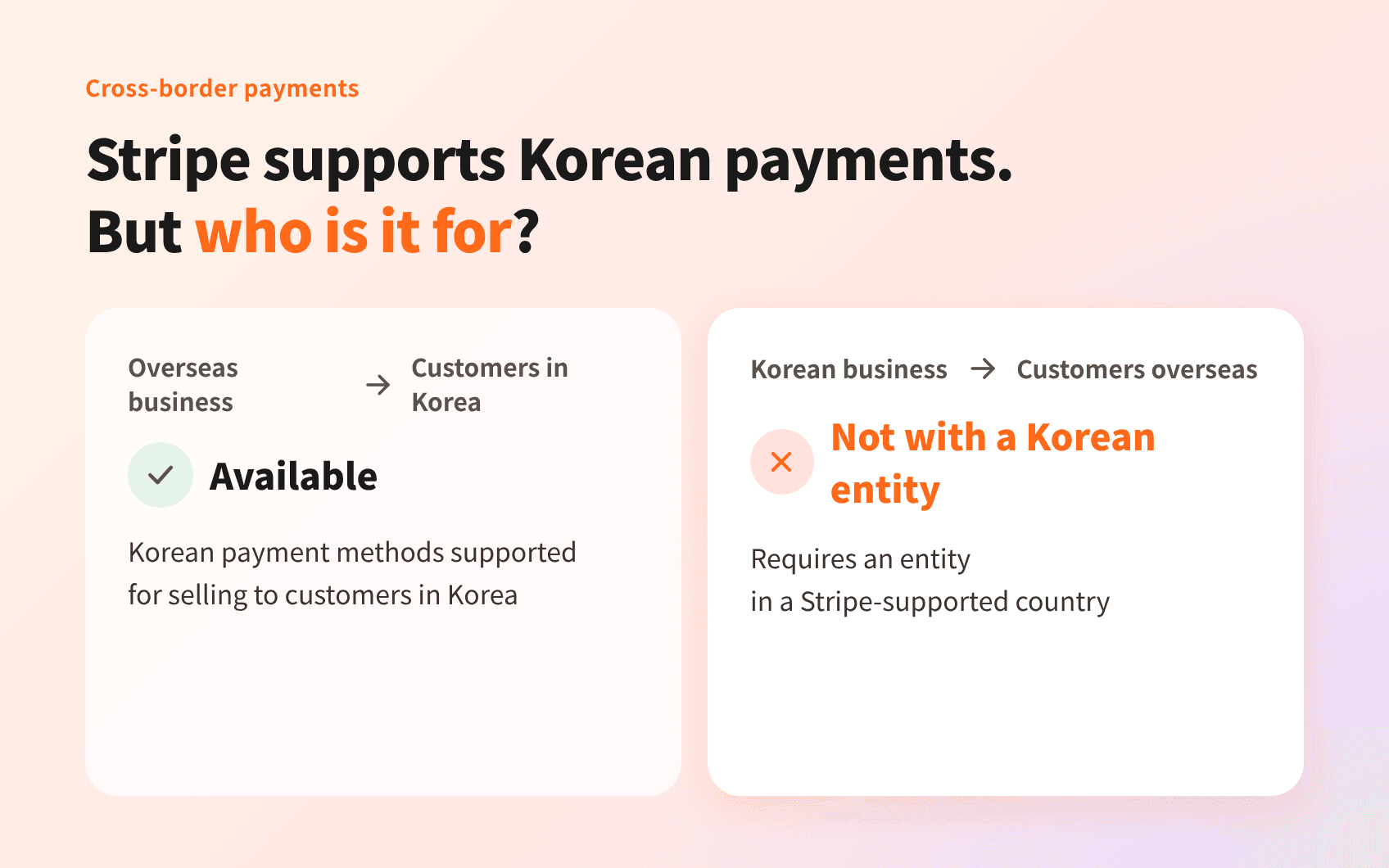
Source: Stripe Docs, South Korean payment methods (docs.stripe.com/payments/countries/korea (opens in a new tab))
Stripe’s Korean payment support is a feature for customers in Korea, not for Korean businesses.
The Costs and Steps of Setting Up an Overseas Entity
To use Stripe, a Korean company needs an entity in a supported country. The best-known route is Stripe Atlas, Stripe’s own US company formation service. From anywhere in the world, you can incorporate a Delaware company (C Corp or LLC) online, then get a tax ID, open a business bank account, and set up a Stripe account in one flow. It costs $500 to incorporate (including government fees and the first year of registered agent service), then $100 a year.
Source: Stripe Atlas (stripe.com/atlas (opens in a new tab))
Incorporating isn’t the hard part. The challenge is what comes after. The moment it exists, a US entity is a company you have to run. Beyond the annual registered agent fee, you may face local accounting and tax costs, and you may have tax obligations in both Korea and the US, so check with a tax professional before deciding on a structure. Revenue lands in the US entity’s bank account, so using it to fund operations in Korea requires a separate transfer process. You’ll also need to check payment methods and regulations for each country you sell to.
Payment fees need to be factored in too. Stripe’s standard fee for a US account is 2.9% + 30¢ per transaction for US-issued cards. Cards issued outside the US add 1.5%, currency conversion adds another 1%, and each chargeback costs $15. Businesses with large payment volumes can negotiate custom pricing.
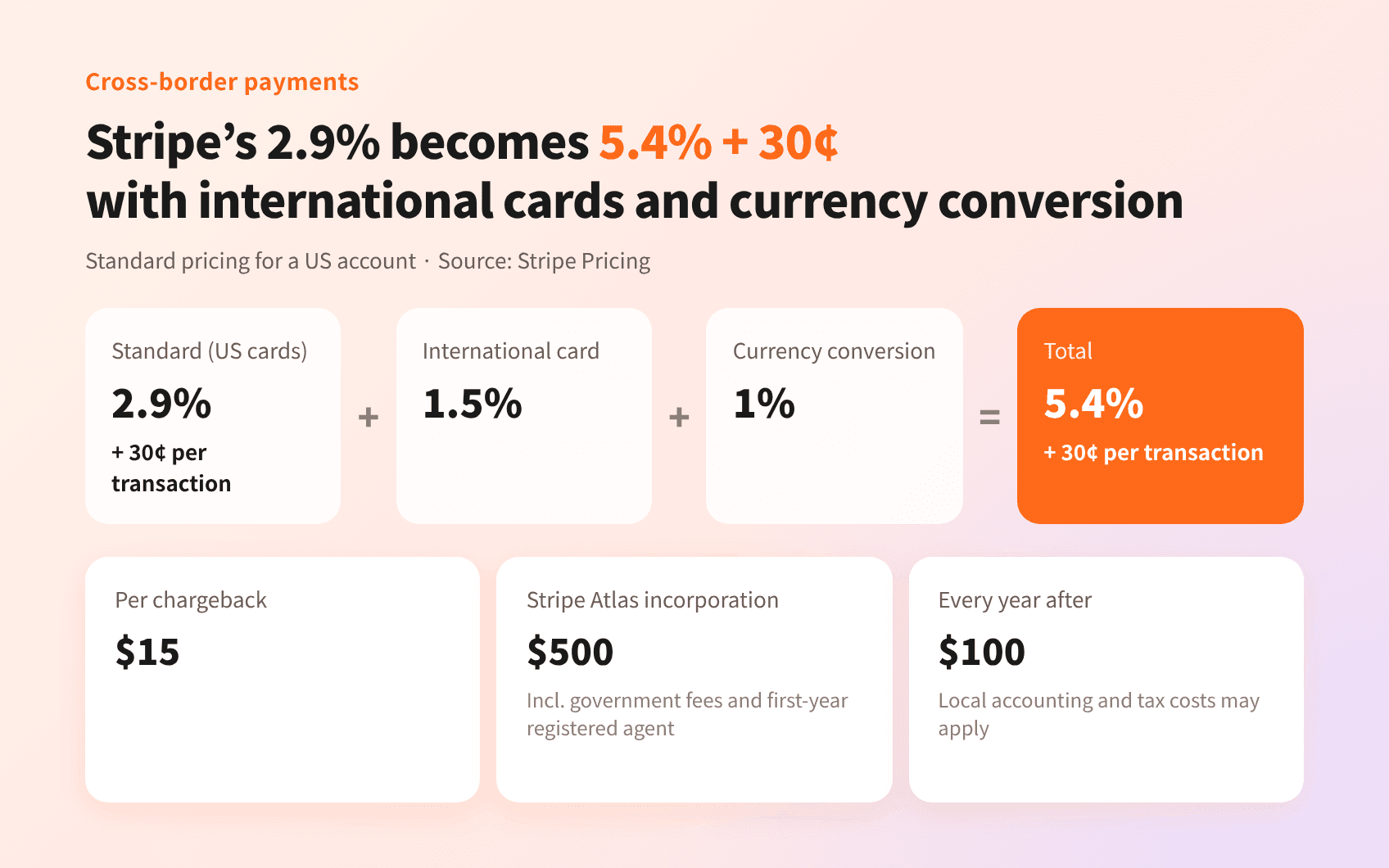
Source: Stripe Pricing (stripe.com/pricing (opens in a new tab))
That makes adopting Stripe less like signing up for a payment service and more like deciding to run an overseas company. If you don’t plan to operate a separate overseas entity, it’s worth looking at other options as well.
How to Accept International Payments With Your Korean Entity
With a payment partner that contracts with Korean entities, you can start accepting international payments without the cost of setting up and maintaining an overseas entity or the tax burden in two countries. Payment providers like Hecto Financial, which contract with Korean entities and connect you to multiple global payment companies at once, fall into this category.
The process usually goes: inquiry → review → payment methods go live. Review criteria differ by country, so your website and the products or services you sell are checked against each country’s standards. Once you pass the review, your payment methods are activated.
The paperwork is also much simpler. Unlike Stripe, you don’t need to set up a local entity, tax ID, address, or bank account. At the final contract stage, you submit basic documents such as your business registration certificate and proof of your corporate bank account.
That said, contract terms alone shouldn’t decide your payment partner. You need to compare fees, approval rates, payment methods, and operational support together. We cover the comparison criteria in Part 2, Choosing a Cross-Border Payment Provider: Why Fees Aren’t Enough, and why approval rates matter in Part 1, What If 4 in 10 Overseas Orders Disappeared at Payment?
From Review to Payment Success Rates: What Hecto Financial Takes On
Hecto Financial handles the review process described above on your behalf, so you don’t have to check and respond to each country’s review criteria yourself. Without setting up a separate overseas entity, you can accept payments from overseas customers with your Korean entity as it is.
After you sign, the Hecto Orchestration Platform tracks success rates by card issuer and payment method and adjusts payment routing as conditions change. For example, if the route with the highest success rate shifts depending on the time of day, payments are routed accordingly to raise success rates.
When an issue is detected, our monitoring team responds first, and operational support is available 24/7. Technical support and the admin dashboard are also offered in Korean, so your team in Korea can easily check payment status and respond to issues.
In most cases, Hecto Financial’s fees are lower than Stripe’s. Actual fees, however, depend on transaction conditions such as the card’s issuing country, the payment currency, and the settlement currency. Once you’ve decided on your target countries and payment terms, talk to us and go through the review to confirm your specific costs.
Contact us about cross-border payments
Contact usFAQ
Q. Can Korean companies use Stripe?
As of October 2026, South Korea isn’t a Stripe-supported country, so you can’t open an account directly with a Korean entity. If you set up an entity in a supported country such as the US and have a tax ID, address, and bank account in that country, you can use Stripe under that entity.
Q. Can a Korean national open a Stripe account in another country?
Yes. According to Stripe Support, the representative’s ID can be any government-issued ID, such as a passport, regardless of nationality. However, the business, tax ID, address, and bank account must all be in the country where you open the account.
Q. Can I open a Stripe account with a virtual bank account?
No. Stripe requires a real bank account in the country where you open the account and doesn’t accept virtual accounts. P.O. boxes aren’t accepted as addresses either.
Sources: Stripe, Global availability (stripe.com/global (opens in a new tab)) / Stripe Support, Requirements to open a Stripe account in another country / Stripe Docs, South Korean payment methods / Stripe Atlas (stripe.com/atlas (opens in a new tab)) / Stripe Pricing (stripe.com/pricing (opens in a new tab), US)