Choosing a Cross-Border Payment Provider: Why Fees Aren’t Enough — 4 Criteria to Compare
Two Quotes, 0.1 Percentage Points Apart: Is That How You Chose?
If you’ve collected quotes from payment providers while expanding overseas, the fee rate was probably the first thing you looked at. Provider A charges 3.0%, Provider B 3.1%. On KRW 1 billion in annual sales, a 0.1-point gap comes to KRW 1 million. It looks like an easy decision.
But a year later, the books sometimes tell the opposite story. You chose the cheaper provider, yet you kept less money. Costs that weren’t on the quote showed up, or more payments failed than you expected.
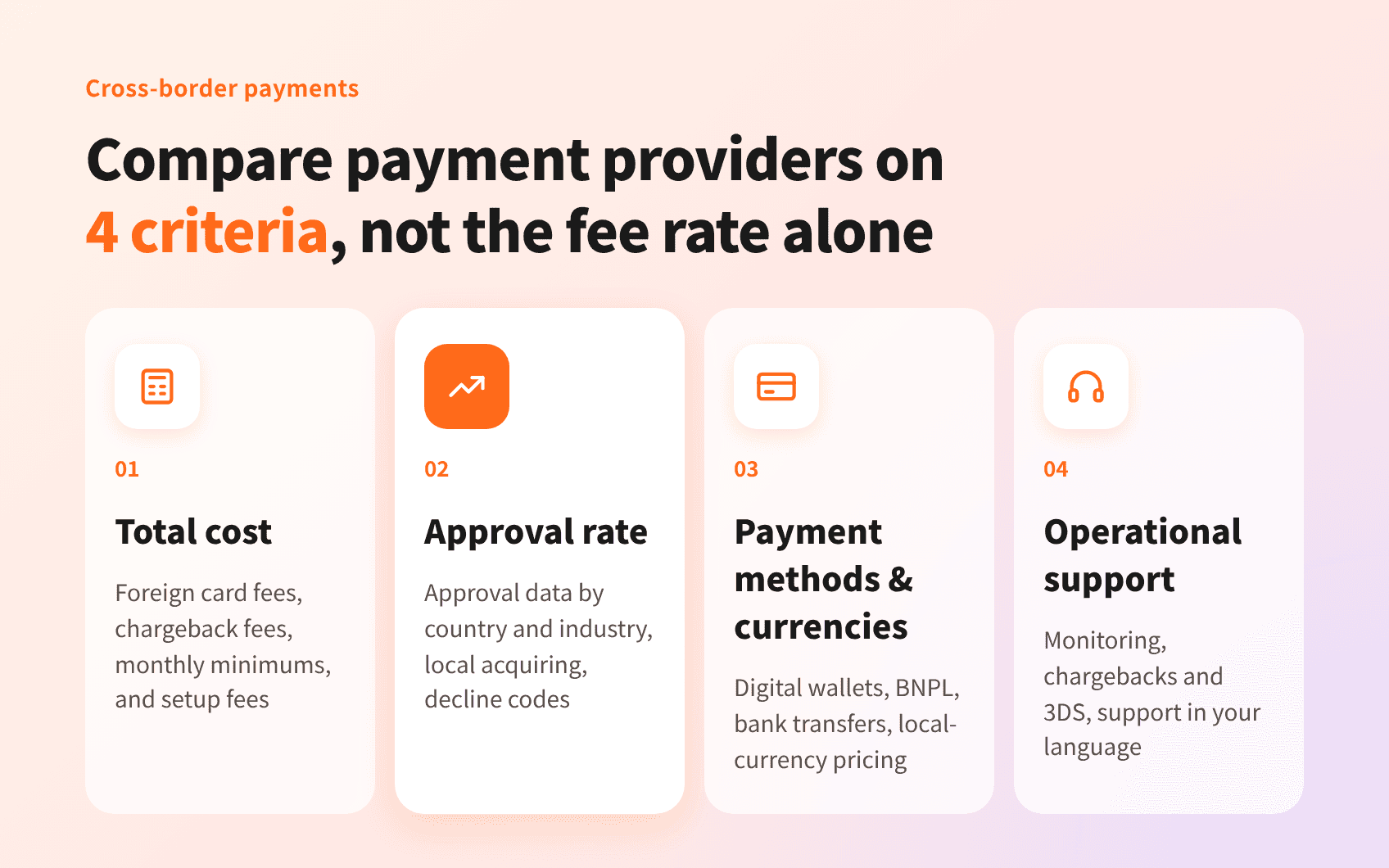
The short answer: Comparing cross-border payment providers means weighing four things together: total cost, approval rate, payment methods, and operational support, not the fee rate alone. This article explains what to check for each one, along with a comparison table you can use as soon as you start requesting quotes.
Why Fees Alone Aren’t Enough to Compare Cross-Border Payment Providers
In Korea, comparing fees alone rarely caused problems. The card company that issues a card also processes (acquires) the payment, so approval rates are nearly the same whichever provider you use.
Overseas, two things change. First, the bank that issues the card and the acquirer that processes the payment are different, so your approval rate depends on which provider you use. Second, beyond the fee rate on the quote, costs such as foreign card fees show up later.
In Korea, the question was how much you pay in fees. Overseas, the question is how much you actually keep.
※ Why approval rates vary in cross-border payments is covered in detail in our previous article, What If 4 in 10 Overseas Orders Disappeared at Payment? A Black Friday Payment Checklist for Cross-Border Sellers.
Higher Fees, More Revenue: How That Happens
Suppose a company with KRW 1 billion in annual cross-border payment attempts is comparing two providers. Provider A charges a lower fee. Provider B charges 0.1 points more but has an approval rate 30 points higher.
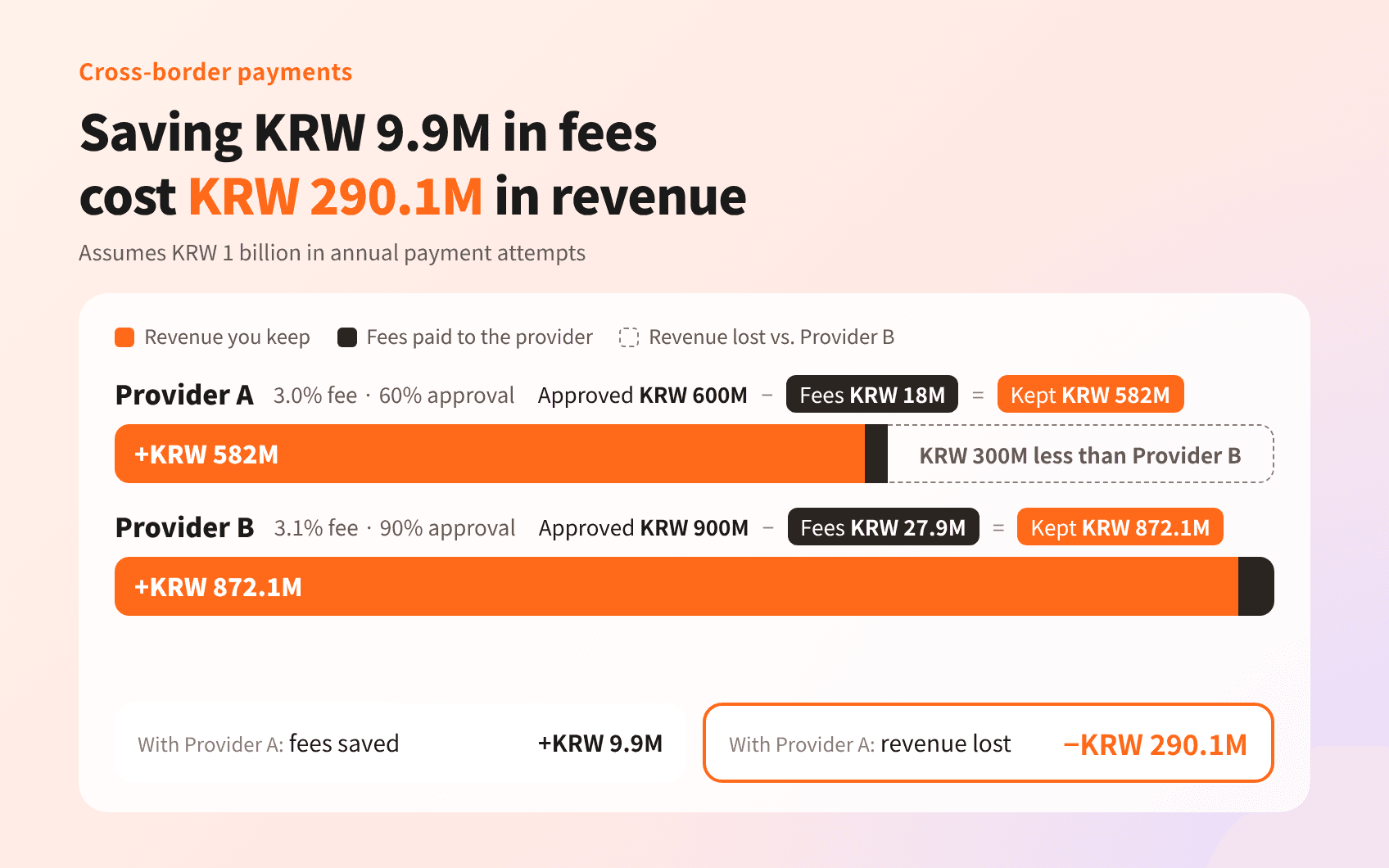
※ A simplified example: KRW 1 billion in payment attempts × approval rate = approved revenue; approved revenue × fee rate = payment fees; approved revenue − payment fees = revenue after fees.
With Provider A, you pay KRW 9.9 million less in fees than with Provider B, but KRW 300 million less in payments go through. Saving KRW 9.9 million cost KRW 300 million in revenue.
The 0.1-point fee difference is on the quote. The 30-point approval rate difference isn’t. When you compare cross-border payment providers, the bigger money is in what you can’t see.
4 Criteria for Comparing Cross-Border Payment Providers
Before you request quotes, prepare questions for each provider based on these four criteria. Here’s what to look at for each one, and why.
①Total Cost: Have You Counted Everything You’ll Actually Pay, Not Just the Quoted Rate?
The fee rate on a quote is only the starting point. When customers pay with cards issued abroad, a separate foreign card fee may apply. When a customer disputes a payment with their card issuer, known as a chargeback, you may also pay a dispute fee for each case.
Ask about monthly minimums and setup fees as well. A monthly minimum means that if your fees for the month fall short of a set amount, you pay the difference. If your overseas sales are still small, fixed costs like these can weigh more than the fee rate itself. Compare providers on the sum of all these costs, not on the fee rate alone.
The benchmark isn’t the fee rate. It’s what you actually pay relative to your revenue.
②Approval Rate: Can You Verify How Often Payments Succeed in Your Target Markets?
The same card payment can have a different approval rate depending on the acquirer and routing it goes through. So rather than a provider’s overall average, ask for approval rate data for the countries you’re entering and your industry. Also check whether local acquiring, which processes payments through an acquirer in the customer’s country, is available.
Once you’ve signed, how you respond to declines determines your approval rate. That starts with being able to see decline data. Check whether you’ll receive a reason code for every decline and whether you can view declines by country.
Card issuers don’t always give a specific reason for a decline, so a single decline rarely tells you the cause. Patterns only emerge as transaction data builds up, and the more data you have, the more payments you can recover. That’s why it matters to start with a partner that can build up and use this data from day one. If you switch providers partway through, you have to rebuild that data from scratch.
This is also why Hecto Financial aims to work with businesses from the moment they start accepting cross-border payments. Over many years, Hecto Financial and its global payment partners have accumulated payment data across many countries and analyzed decline codes by country and card issuer. Drawing on that expertise and our communication channels with card issuers, we identify the causes of recurring declines and turn them into approvals.
※ How to recover declined payments and how local acquiring works are covered in What If 4 in 10 Overseas Orders Disappeared at Payment? A Black Friday Payment Checklist for Cross-Border Sellers.
③Payment Methods and Currencies: Do They Support What Your Customers Actually Use?
Preferred payment methods vary from country to country. Cards dominate in some markets, while digital wallets, buy now, pay later (BNPL), or bank transfers are more common in others. If a customer’s preferred method isn’t available, they leave before even trying to pay. Choose a few of your main markets and start by checking whether the provider supports the methods most widely used there.
Also check whether customers can see prices and pay in their own currency.
When choosing payment methods, start from how your customers in each market actually pay.
④Operational Support: Will You Have the Data and the People When Something Goes Wrong?
With cross-border payments, running them is harder than setting them up. When declines suddenly spike in one country, chargebacks pile up, or an integration error occurs, you need monitoring that catches the problem early and a contact person who can dig into the cause with you.
Check whether the provider supports chargeback handling and 3DS (cardholder authentication) setup. Whether the integration method fits your development resources, and whether you can get technical support in your team’s language and time zone, also make a real difference in day-to-day operations.
Switching providers after problems arise is costly. Check operational support before you sign.
Cross-Border Payment Provider Comparison Table: Fill It In as You Collect Quotes
Copy the table below and fill in one column for each provider that sends you a quote. Wherever you’re left with blanks, ask more questions before you sign.
FAQ
Q. How is a cross-border payment provider different from a domestic provider in Korea?
A domestic provider in Korea connects you to Korean card companies and payment methods, while a cross-border provider processes overseas cards and payment methods. The biggest differences are that overseas approval rates vary by acquirer and processing route, and that additional costs such as foreign card fees apply.
Q. Can we use a cross-border payment provider without an overseas entity?
It depends on the provider. Global payment companies may require a local entity when you contract with them directly, while some providers, such as Hecto Financial, let you sign with your Korean entity, with no overseas entity needed. Check entity requirements before you sign.
Q. How can we check approval rates before signing?
Ask for approval rate data for your target countries and industry, or for references from similar clients. If possible, you can also test with a few countries or a portion of your traffic before making a decision.
Q. Is it better to use multiple payment providers?
Using several providers keeps payments running if one goes down and lets you pick the best route for each country. On the other hand, integration and management become more complex, and splitting your volume can weaken your position in fee negotiations. With a provider like Hecto Financial, which is already connected to multiple global payment service providers (PSPs), a single integration lets you process payments through different PSPs as conditions change, so you don’t have to manage several providers yourself.
In the End, Compare How Much You Keep
The fee rate on a quote is the easiest number to compare. But in cross-border payments, hidden costs and failed payments make the bigger difference. Your comparison isn’t complete until you’ve looked at total cost, approval rate, payment methods, and operational support together.
So what about the well-known global payment services? In the next article, we cover what Korean companies should check before adopting Stripe.
Next → Can Korean Companies Use Stripe? Requirements and Limitations
Reference: Payment structure and contracting barriers with global payment companies — Hecto Financial cross-border payments seminar materials (August 2026)
Wondering which cross-border payment partner to choose?
Contact us